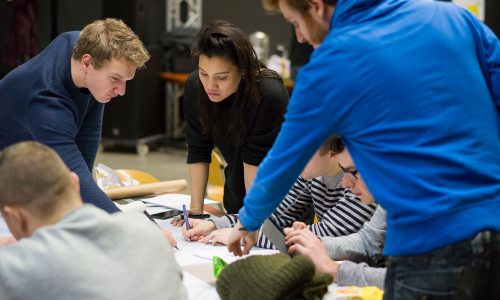
A research studio

Classical architecture as if we almost forgot about it

Publicatie datum: 27 augustus 2010 11:20 | Door: Mauro Parravicini

Being invited as visiting critic at the Rotterdam Academy of Architecture and Urban Design is an experience which starts with a boat trip from the city centre. The catamaran picks you up perfectly on time, a few meters away from the Erasmusbrug. On the other side of the river you see the cranes of Wilhelminapier. Over there Alvaro Siza is completing his tower and Rem Koolhaas will soon achieve his vertical city, only a couple of years after Norman Foster, Renzo Piano and Mecanoo erected their towers.

The Roman Classical System, architectural typologies as unifying symbols in the Roman Empire - Femke Feenstra


The trip on the boat is fast and quiet. Inside they’re showing a match of the soccer world cup, as if people would not be aware of the amazing architectural scenario of the banks of the New Meuse. The harbour of Rotterdam has moved out, closer to the coast. Meanwhile the redevelopment of the former docks tries to move the heart of city towards its spread southern edge. The Rotterdam Academy belongs to this world. It is located in the former headquarters of the Rotterdamsche Droogdok Maatschappij on the south banks in a surreal context made of containers and huge infrastructures.
No wonder that Dutch architecture developed in such extreme expressions!

In that context it is quite surprising to see the content of the research studio led by Fernando Donis: The Classical City. As if we almost forgot about it, the studio chooses to awake our anaesthetized minds. But also the student’s ones. A huge research with a high level of graphical representations. White panels, clean sections, plans, axonometrics. Doric, Ionic, Corinthian orders. Arches, proportions. Everything finally talks to our inner truth. Our architecture comes from there. Firmitas, utilitas, venustas. Where did it end up?


Maybe as never before, the students are confronted with this question. After all, they are looking into our common history to find answers for tomorrow’s architecture. Chris van Langen’s school is keen on stressing the relations between old and new.


More than just looking at the latest muscular exhibitions in the iconic delirium of contemporary architecture, I believe that this experience can make the students aware of their possibilities and limitations. When you look at the plan of the city of Timgad next to the Baths of Diocletian, and to the monumental functionality of the Colosseum next to the extension of the Roman Empire, you are facing essential questions about the interlaced development of a city, a society and a nation. What is the Roman Classical System behind all this?

By consequence we can read other relevant questions between the lines. What’s our contemporary system? What’s our part in it? Do we want to change it? Do we want to guide it? Maybe the students are not ready yet for an answer. I wouldn’t worry. We are all struggling with it. Important is that on the way back along the water they can look around them and search for signs of a system, traces of our history, read between the lines, and prepare to be the actors of the next city.

Mauro Parravicini (1969) is architect in Rotterdam. Voordat Mauro in 2010 zijn eigen bureau oprichtte, heeft hij onder andere bij Mecanoo Architecten, OMA, Giancarlo De Carlo e Associati en de Renzo Piano Building Workshop gewerkt. Daarnaast heeft hij les gegeven aan de Politecnico di Torino, de Università di Camerino en de Cornell University. Ook was hij jurylid bij diverse prijsvragen en criticus op onder andere de Architectural Association, het Berlage Instituut en de Rotterdamse Academie van Bouwkunst; op de RAvB was hij externe criticus bij de afronding van het onderzoeksatelier ‘The Classical City’ in juni 2010.

Arch of Titus, a monumental structure, symbolizing the glory of Rome - Frederik Pöll en Harm Janssen
The Classical Orders, standardization of and within the building elements - Harm Janssen
Baths of Diocletian, Roman social Utopia - Ron van Logchem en Femke Feenstra
Timgad, rational planning of a Roman city - Frederik Pöll
The Colosseum, a showcase of the classes in Roman society - Frank van Leersum
The Roman Empire in its maximum extent - Frank van Leersum

Reacties

Plaats een reactie

De inhoud van dit veld is privé en zal niet openbaar worden gemaakt.
By submitting this form, you accept the Mollom privacy policy.