
Afstudeerpresentatie Rik Blank
vrijdag 23 mei, 16u00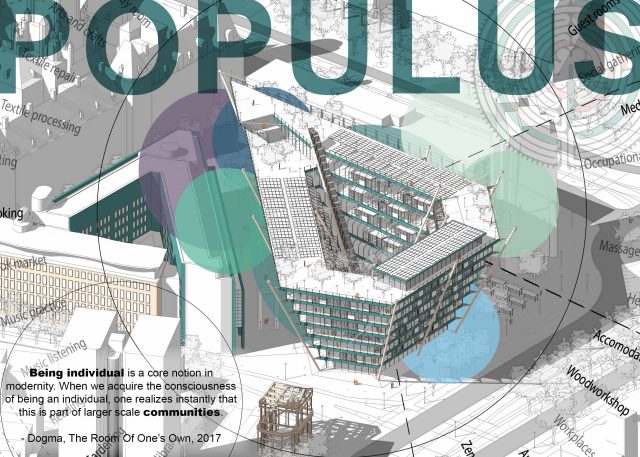
Vrijdag 23 mei vindt de afstudeerpresentatie plaats van Rik Blank (Architectuur) met als onderwerp “Populus; Architecture, populism, democracy and solitude”
Commissie:
Voorzitter : Caspar Frenken (RAVB)
Mentor : Claudio Saccucci (Studio Verter)
Externe criticus : Ben Weir (Ben Weir Architect)
Toegevoegde criticus : Hans Teerds (Benthem Crouwel Architects)
Afstudeerdatum en locatie:
Vrijdag 23 mei om 16u00
Locatie: Rotterdamse Academie Van Bouwkunst
Populus; Architecture, populism, democracy and solitude
Architecture is inherently a political profession. The word ‘Politics’ stems from the Greek word Polis
(city), and signified all tasks involved in keeping the city-organism functional. Hence it governed
agreements, interactions and arrangements between people, a description which still applies today.
Architecture shapes the physical world and mediates interactions. This political aspect creates a
symbiotic relationship, and thus responsibility, in relating to society.
Present-day politics is colored by both left- and rightwing populism. Populism is a political ideology
defined by its central claim of opposing the established order as the voice of the common people.
Populism is inherent to democracy, but the momentum driven by modernity, relative deprivation and
mass culture has created a landscape of populist governments. Research indicates that people in The
Netherlands are increasingly fearful, more stressed, lonelier, with lower relative incomes, more
scared, experiencing a decrease in free speech, and are less positive about their outlook on life. In
such a time of complexity and instability, populists convey seemingly unambiguous answers, but
actually produce increased inequality, a decrease in freedom of press and speech, and reduced
influence by private citizens… populist answers don’t seem to offer sustainable solutions.
Straightforward solutions; the motivation seems clear. But where does our political identity, which fuels
the push towards populism, actually take shape? Historically, ideas on politics were conversed in
(semi-) public spaces, notably streets and squares. Presently, however, political identity forms through
modern media from within the dwelling, in the private sphere.
Hence, the dwelling is the place to look for a response. The functioning of the modern apartment
dwelling (all supportive functions within four walls) emerged as a monastic cell in the Middle Ages,
and became the quintessential typology in urban planning and architecture during the industrial
revolution. Modernity’s push towards individuality parallels the exponential rise in individual living
units, the demise of collective functions, and the dissolving of the private sphere through mass media.
Loneliness and individuality are perpetuated; populism serves as political opium.
The way out of this trap is through creating stimulating means for people to be in solitude whilst being
collective, in everyday life in the sphere of dwelling. The graduation project thus takes a stance
against the described modern dwelling. It showcases a method of design. Instead of inner city
dwelling of loneliness, the core collective typology of the monastic form is reinserted into apartment
dwelling, creating a balance; 30% programming, 30% openness/transition, 30% housing, coinciding
with urbanity as a whole.
The project provides a speculative design for the to-be-demolished Pompenburgflat in Rotterdam,
once an expression of socially motivated development through the municipality. The new design
opens the city for public programming, and mirrors the spatial and cultural context through materiality,
scale, and urban form. The collective governance is structured on the basis of temporal draw. The
structure is collectively owned, and complementary to the urban plan. Lucrative programming is
woven into the fabric, alongside care, social and educational uses; profits flow back into the collective.
This synergetic building typology structures minimal dwelling through the collective labyrinthine
continuous corridor, producing collective functioning, whilst providing individual retreat to solitude.
Within this balance exists the architectural key to responding to contemporary normative ‘political’
regression.